

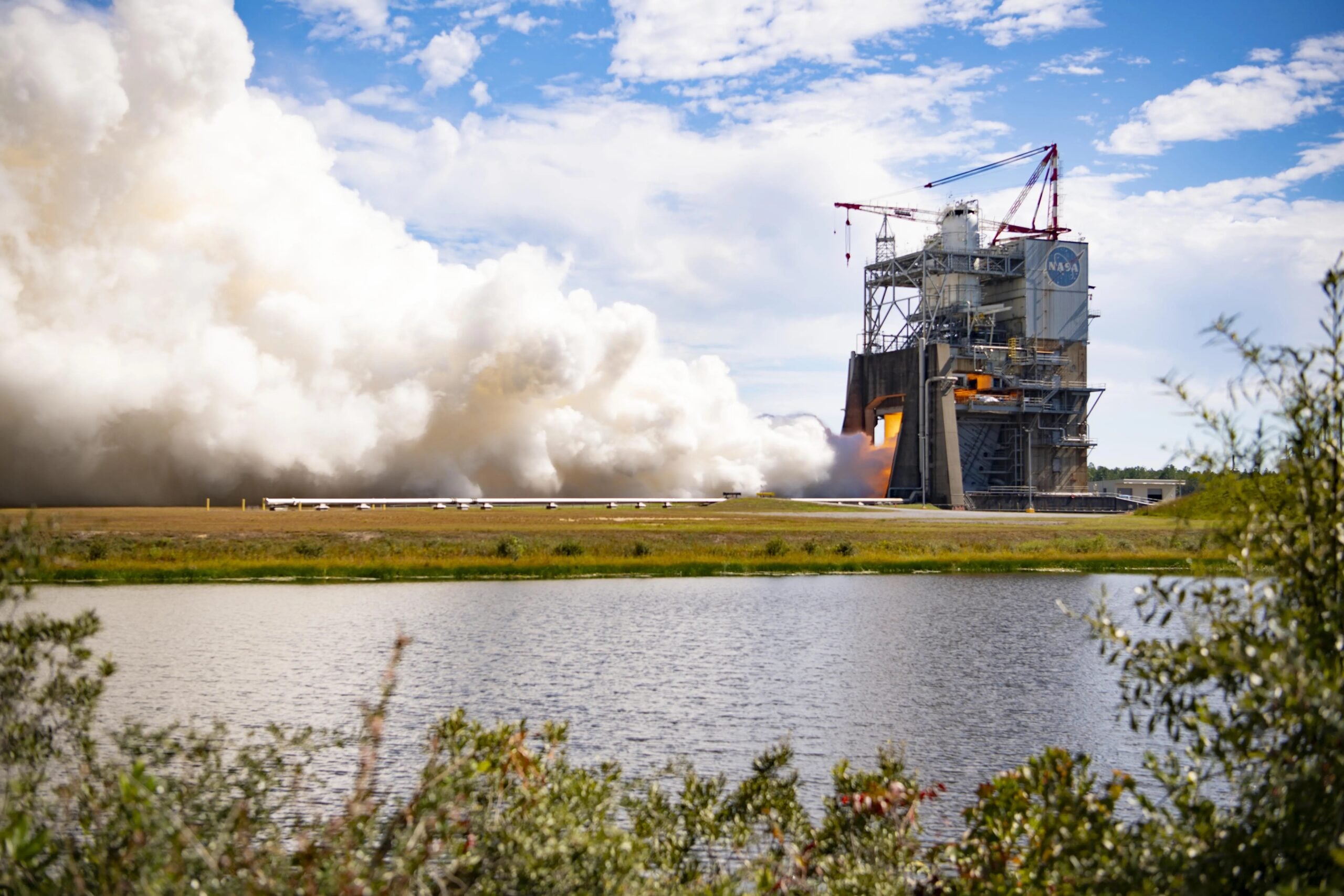
The hot-fire test in Mississippi matched the length of an SLS launch burn and reached 111% power. The engine itself will not fly.
NASA has fired RS-25 development engine No. 10001 for about eight and a half minutes at the Fred Haise Test Stand at its Stennis Space Center, near Bay St Louis, Mississippi. The agency’s account dates the test to 21 October. The 500-second firing equals the time RS-25 engines burn during the launch of the Space Launch System (SLS) rocket. Its main aims were to acceptance test RS-25 flight components for future Artemis missions and to validate a new thermal protection system for the engine nozzle.
What the test covered
Operators took the engine to the 111% power level, which matches the thrust needed for new production engines to launch the SLS and the Orion spacecraft to orbit. NASA says the new thermal protection system shields the nozzle from the heat around the SLS during launch.
The engine will not be used in flight. NASA and its prime contractor, L3Harris Technologies, nevertheless use hot-fire tests to gather data to improve engine performance and reliability. The tests were run by a team of operators from NASA, L3Harris and Nova Space Solutions. All RS-25 engines are tested and proven flightworthy at Stennis before use. Four of them produce up to 2 million pounds of combined thrust to help launch the SLS on each Artemis mission.
According to the research notes, the 111% figure refers to the engine’s original rated thrust baseline and is not an unsafe overload. Late Space Shuttle missions flew at 104.5%, and the first four SLS flights at 109%. NASA has tested engines to 113% to establish extra performance margins. The four engines supply only part of the SLS’s total launch thrust, about 8.8 million pounds. Its two solid rocket boosters provide most of that during the early climb.
Why the nozzle insulation matters
NASA says RS-25 engines face a harsher heating environment on the SLS than on the Space Shuttle. The SLS carries four engines at the base of its core stage, instead of the shuttle’s three, and they sit close to two large solid rocket boosters. The nozzles face intense radiant heat during roughly the first two minutes of flight, and booster separation adds another heating challenge.
The redesigned nozzle has more than 1,000 tubes carrying extremely cold liquid hydrogen to stop it overheating. The insulation protects the outside of the nozzle from surrounding heat, and the hydrogen cooling protects it from its own exhaust.
Cheaper, simpler engines
NASA says the redesigned nozzle jacket uses four large metal cones in place of 37 separate sections, which cuts nozzle manufacturing costs by more than 20%. Across the whole redesigned engine, improved manufacturing could cut production costs by about 30% compared with the original shuttle-era engines. More than 700 welds have been removed through design simplification. Some parts are 3D printed, and combustion chamber bonding and inspection methods have been improved. NASA has contracted L3Harris for 24 newly manufactured RS-25 engines. The remaining shuttle engines were upgraded for the first four SLS missions, and new engines will begin replacing them with Artemis V. Unlike on the shuttle, RS-25 engines used on the SLS are expended with the core stage.
A long test history
NASA’s records show that engine No. 10001 was fired 13 times between December 2022 and June 2023, for 6,779.5 seconds in total, in an earlier certification programme. Its longest burn lasted 720 seconds. A 12-test certification campaign finished on 3 April 2024, and NASA said it had completed the testing needed to restart production of redesigned engines. The latest test is therefore about acceptance of flight components and the thermal protection system, not original certification of the engine design.
