
Could Tasmanian Tiger Return to Earth?
World
October 17, 2024 13:20
tasmania, australia - Scientists claim 99.9% matching DNA code after gruesome discovery
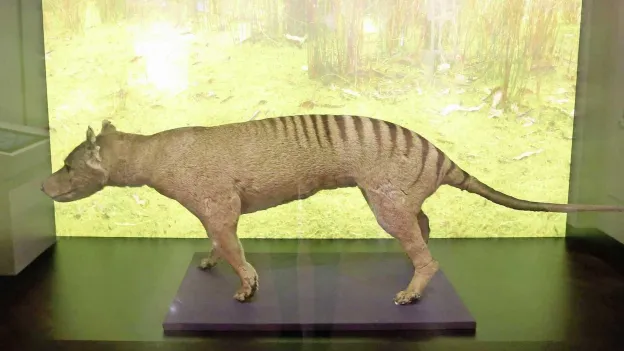
The Tasmanian tiger, a wolf-like marsupial that once roamed the forests of Tasmania, may potentially be brought back to Earth, according to a team of American and Australian researchers. They claim a series of scientific breakthroughs.
The last Tasmanian tiger died in 1936 in a zoo in Hobart, Australia. The animal fell victim to the growing livestock industry in Tasmania.
According to Colossal Biosciences, a Dallas-based company in the United States, the extinct species is an ideal candidate for so-called 'de-extinction.' The start-up previously announced its intention to also revive the extinct dodo and woolly mammoth. The company utilizes the latest developments in genetic editing and reproductive biology.
Most attempts to reconstruct the genetic code of long-extinct species are hindered by the fact that DNA is fragile and deteriorates over time. The company claims to be working with 'the best-preserved material' they have ever had access to. 'It's rare to have a sample that allows you to push the boundaries so far,' said lead researcher Beth Shapiro.
From a 108-year-old specimen preserved in alcohol in a forgotten museum drawer in Melbourne, Australia, the team extracted a DNA code that they claim matches the original by 99.9%. The scientists were surprised: the animal's head had been sitting in a large jar and was overlooked for years. 'It was quite gruesome, a completely horrifying sight. People had hacked off large chunks,' said one of the researchers.
The researchers claim to be able to extract many fragile RNA molecules from the gruesome specimen, providing the team with more information about the genes and tissues of the animal.
'With this new information, we can determine what the animal can taste, what it can smell, what kind of vision it has, and even how its brain functions,' said Professor Andrew Pask of the University of Melbourne to Sky News.
However, the genes of the animal are just one step towards its resurrection. The company utilizes genetic editing techniques to alter the genome – the complete set of genetic instructions – of a close living relative: the hamster-like fat-tailed gerbil, in order to create a creature that closely resembles the Tasmanian tiger.
According to Sky News, the researchers claim to have performed more than 300 genetic 'edits' on the lab-grown gerbil cells. They have also learned how to induce ovulation in the small marsupial and grow embryos outside the womb, similar to techniques used in human IVF.
However, there is also criticism. Conservationists argue that the millions of dollars invested by companies like Colossus could be better spent on preserving habitats of currently endangered species. This includes a fifth of Australia's native mammals.
Others have moral objections to reviving long-extinct animals in habitats damaged by human activities. Some scientists are cynical about the chances of the American company. Bringing extinct animals back to life would technically be impossible. 'De-extinction is a fairy-tale science,' said Professor Jeremy Austin of the Australian Centre for Ancient DNA in 2022 when the project was announced.

Leave a comment