
Challenges Facing Germany: A Comprehensive Analysis
World
November 7, 2024 21:00
germany - Germany, once a powerhouse in Europe, is facing a myriad of challenges that are impacting its economy, social fabric, and political landscape. This article delves into the various issues plaguing the country.
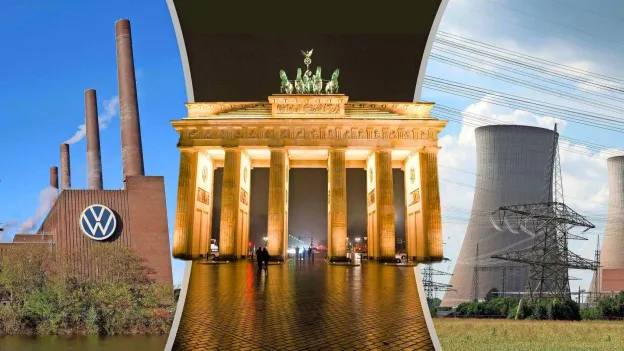
The engine of the European Union has been sputtering for some time now. 'Made in Germany' no longer guarantees success. The automotive industry in the country is facing significant challenges, with costs at the largest European automaker Volkswagen soaring and shareholders demanding higher profits. The closure of three factories is now being considered.
In the wake of the COVID-19 pandemic, Berlin spent hundreds of billions to protect the economy. Additionally, Chancellor Scholz swiftly reacted to Moscow's invasion of Ukraine in February 2022 by earmarking an additional 100 billion euros for the defense budget.
Mass immigration in recent years has also taken a toll on Germany. The costs of hosting refugees have skyrocketed to fifty billion euros. Since former Chancellor Angela Merkel allowed one and a half million refugees from Arab and African countries to enter the country in 2015, the public sentiment has shifted. The influx of over a million people from Ukraine following the conflict further strained the situation.
Integrating individuals from diverse cultures into the workforce has proven challenging. Language barriers, traumatic experiences, and cultural differences have hindered the employment of many immigrants. A significant portion of Ukrainian immigrants, particularly mothers with young children, struggle to find employment.
One major issue that has emerged is the rise in criminal activities involving foreigners. Several terrorist attacks by illegal migrants have occurred, such as the one at the Christmas market in Berlin. Germans have been victims of stabbings in trains, as seen in Würzburg and Mecklenburg. Recently, a right-wing activist was attacked in Mannheim, and an officer was killed. Tragically, three unsuspecting victims lost their lives in Solingen.
With a budget of nearly five hundred billion euros, the German government is facing challenges in parliament, particularly with the dismissal of the finance minister and his neoliberal party. There is a significant budget deficit for the upcoming year which cannot be resolved before the end of December.
Germany risks becoming a 'lame duck' as the costs of its generous welfare state soar. The pandemic and the conflict in the eastern NATO flank have led to astronomical expenses. Simultaneously, a stagnant economy has resulted in reduced revenues. There is a budget shortfall of at least thirteen billion euros, and legal constraints limit excessive borrowing, impeding investments.
Germany's energy landscape is rapidly changing due to European climate regulations. The use of polluting coal has been phased out, but the environmental impact of lignite coal mining persists in western Germany. Following the Fukushima disaster, former Chancellor Angela Merkel decided to phase out all nuclear power plants in Germany. Criticism of this decision has arisen due to nuclear energy's lack of carbon emissions.
Germany's energy dependency on Russia has been a concern. Merkel and her predecessor, Gerhard Schröder, facilitated this reliance, with Schröder still serving as a Gazprom lobbyist for Vladimir Putin. The suspension of gas supply through Nord Stream, followed by the pipeline's destruction, prompted Berlin to swiftly develop LNG terminals on the North and Baltic Seas.
Recent local elections in three former East German states saw populist parties gaining significant support. The far-right AfD rejects sanctions against Moscow and advocates for a peace agreement similar to Putin's approach. Such views are untenable for mainstream parties in the Bundestag. Three AfD politicians were recently arrested on terrorism charges and attempted coup allegations.
The Kremlin not only finds support from the far-right party but also from the BSW movement led by left-wing icon Sahra Wagenknecht. Her new party garnered significant support in the former GDR, her childhood home. Wagenknecht's opposition to the presence of American missiles in Germany has complicated coalition talks in Saxony and likely Thuringia.
The Green party's influence in the government has led to extensive construction of wind turbines across Germany. Solar panels are increasingly appearing along the autobahns and rooftops. However, the subsidies for these initiatives will be discontinued at the end of the year. Furthermore, nearly sixty billion euros have been allocated for climate measures.
Germany's sluggish innovation has posed a challenge. The dominant automotive sector clung to combustion engines, losing ground to the faster-paced American Tesla and more cost-effective Chinese companies like BYD. Germany's innovation model is faltering, bureaucratic red tape consumes excessive time, and high labor costs threaten to drive businesses abroad. The construction halt of a chip factory in Magdeburg by the American company Intel, despite ten billion euros in subsidies, illustrates this trend.

Leave a comment