
Almost Three-Quarters of Wild Animals Disappeared Since 1970: How Alarming Is That?
World
October 10, 2024 17:10
amsterdam - The World Wildlife Fund (WWF) reports a significant decline in the number of wild animals since 1970, with populations of mammals, fish, and reptiles decreasing by nearly three-quarters globally. What are the causes of this decline, what does it mean for humanity, and what can be done about it? Five questions.
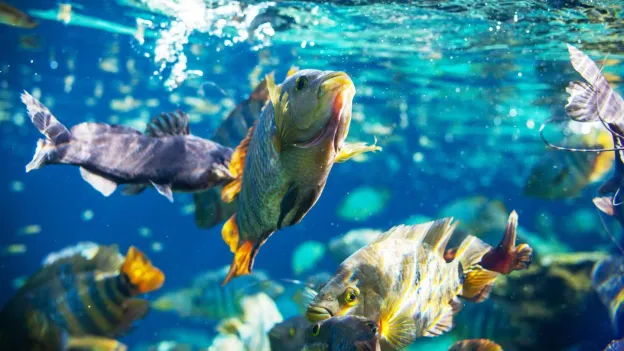
Between 1970 and 2020, populations of mammals, birds, amphibians, reptiles, and fish have declined by 73 percent globally. Among fish and amphibians, that percentage rises to 85 percent. The largest declines are observed in Latin America and the Caribbean.
The decrease can be attributed to habitat loss, water obstacles such as dams and weirs, extensive deforestation, climate change, overfishing, poaching, and pollution. This puts habitats such as the Amazon and coral reefs at risk of irreversible changes.
The figures do require some nuance. The WWF cannot monitor wild animals everywhere. Consider Suriname, which is 93 percent forest and thus inaccessible. Monitoring mainly takes place in areas between cities and forest edges. The shrinking living space for wild animals in these areas is reflected in the statistics. And of course, the decline in the number of animals is not only since 1970, when the WWF began monitoring.
Biologist Auke-Florian Hiemstra from the research institute and natural history museum Naturalis describes the numbers as 'alarming' and expresses 'serious concerns.' He compares biodiversity to a tower of blocks. 'Biodiversity consists of all life forms that need each other. If you see that as a tower of blocks, you can remove some blocks here and there, but after a while, that tower begins to wobble.'
'Undoubtedly, there are species that we can do without, but what is concerning is that we are now losing so many wild animals. The disappearance of one species can be compensated for in the tower, but if you remove so many blocks, the tower will collapse after a while. These figures show that the tower is seriously wobbling.'
If you remove too many blocks from the tower, we as humans will feel it too. 'People are on top of the tower. If that tower starts to wobble or collapse, we will be the ones to suffer.' Hiemstra cites bats as a Dutch example.
'If you know how many mosquitoes a bat catches, the bat should be our best friend. They eat half their body weight in mosquitoes per day. That is astronomical. If you just want to sit outside without getting bitten by mosquitoes all the time, the bat is very useful. This shows that if a species disappears, the system becomes unbalanced. If a few species disappear, we will notice.'
The WWF calls for more effective nature conservation and an approach to the main reasons for biodiversity loss (see question 1). The Netherlands performs poorly in Europe in this regard: only Belgium and Malta have less nature than other countries.
According to Hiemstra, we can also do a lot at home to protect biodiversity. 'Remove tiles from your garden. Create a wild area, and you will suddenly see hedgehogs roaming around. They eat snails. Allowing the garden to be a bit more natural is something very direct that we can already do.'
The number of European bisons, mountain gorillas, and snow leopards has increased. However, this is just a glimmer of hope. Jelle de Jong, director of the Dutch WWF branch, says, 'The success stories offer hope, but they should not remain only as regional successes.'

Leave a comment