
The Lebanese Tragedy: How the 'Switzerland of the Middle East' Became a Failed State
World
October 1, 2024 13:20
amsterdam - Lebanon, once known as the 'Switzerland of the Middle East', lost its status due to internal discord among its diverse population, the Palestinian issue, and multiple Israeli invasions.
During the day, they would deposit their fortunes in one of the many banks and at night they would dive into the nightlife. Lebanon was a magnet for many Arabs from the Persian Gulf in the two, three decades after World War II. It is a stretch to call Beirut the Dubai of that era, as the differences are too great. However, in the absence of a better comparison, the wealth in Lebanon attracted jet setters from around the world.
The storms in the rest of the Middle East largely bypassed Lebanon, thanks in large part to the highly diverse composition of the population. The country is a patchwork of larger and smaller ethnic and religious groups. Muslims constitute roughly the largest demographic group, with approximately equal numbers of Sunnis and Shiites. Christians are also present in large numbers. Maronites, Greek Orthodox, Protestants, and other Christian denominations represent between a third and half of the population. The rest of the Lebanese population consists of minorities such as the Druze and the Alawites.
All these different larger and smaller groups largely kept each other in balance for a long time. In the early 1970s, however, the mix of the cocktail was suddenly disrupted by developments in Jordan. King Hussein was fed up with the activities of the Palestinian Liberation Organization (PLO) in his country and cracked down on them. It is too detailed to describe Black September, as this de facto civil war later came to be known, but the result was that many Palestinians fled from Jordan to Lebanon.
This influx suddenly exposed the underlying sectarian tensions. Relations especially deteriorated between Maronites - the largest Christian group in Lebanon - and the Sunni Palestinians. In 1975, a civil war broke out in which a coalition of Christian groups fought against the PLO and other Muslim militias. Meanwhile, the Palestinian liberation organization continued attacking Israel from Lebanon and after an extremely bloody attack in 1978 that killed 37 Israelis and wounded 76, the Jewish state intervened in the conflict.
Initially, the Israeli intervention resembled the military action that started on Monday night. Israel wanted to cleanse the area between the border and the Litani River, located about 25 kilometers to the north, of Palestinian terrorists. The Israelis received assistance from some Christian militias. However, the invasion degenerated into a protracted conflict that dragged on for years, as the Palestinians simply withdrew north of the Litani. In 1982, Israel launched a large-scale invasion, advancing to Beirut.
Later that year, Israel largely withdrew back to the border area, after a - unfulfilled - promise that the PLO would withdraw from Lebanon, but the civil war continued. By then, a new player had emerged: Hezbollah. With the support of Iran, which had transformed into an Islamic republic after the revolution in 1979, this Shiite group rapidly rose to become one of the most important players in the country. First through attacks, such as the 1983 bombings on the barracks in Beirut where American marines and French soldiers were stationed, and later as an actual militia.
By the end of the civil war in 1990, Hezbollah was so powerful that it managed to negotiate a special status for itself. It was allowed to maintain a militia, while all other ethnic and religious groups had their fighters join the Lebanese army. This laid the foundation for the state within the Lebanese state that Hezbollah is today. Meanwhile, Israeli troops remained in the south of Lebanon, which frequently led to violent confrontations. Israel completely withdrew from the neighboring country in 2000.
Not all foreign troops had disappeared from Lebanon. The UN peacekeeping force UNIFIL was (and still is) present, and Syrian troops, which had intervened in the conflict from the beginning of the civil war, remained stationed in Lebanon. Lebanese dissatisfaction with the Syrians erupted in 2005 after the assassination of Lebanese Prime Minister Rafik Hariri, which incidentally was the work of Hezbollah. Under pressure from this popular anger, combined with pressure from the West, Syria later withdrew that year.
Nevertheless, peace did not return to Lebanon. Just a year later, on July 12, 2006, Israel invaded the neighboring country again, this time in response to attacks by Hezbollah with rockets and fighters. A month later, the war ended, in part due to the agreement that Hezbollah would disarm, which incidentally did not happen. This was because the group had to defend itself against other factions within fragmented Lebanon, who blamed Hezbollah for the Israeli invasion.
The second decade of this century was a period of relative calm in Lebanon. Relatively, because the Arab Spring in neighboring Syria caused enormous unrest and ultimately led to a civil war, prompting many Syrians to flee to Lebanese territory. At the height of this refugee crisis, approximately a quarter of the Lebanese population consisted of Syrians. For Hezbollah, this period was mainly one of military activity in Syria, where the group fought alongside the forces of dictator Bashar al-Assad. During the Syrian civil war, ties with Iran were further strengthened.
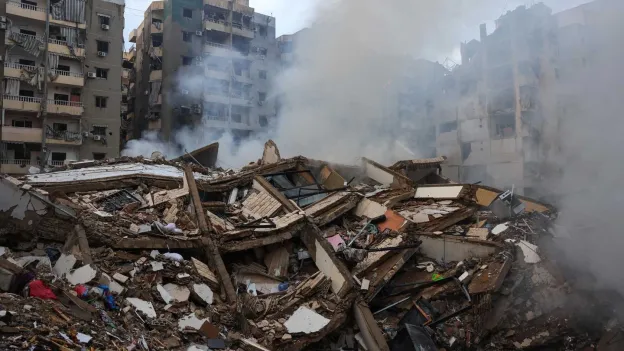
The current Israeli ground offensive in southern Lebanon.
During this period, the Lebanese economy completely collapsed. In combination with the massive explosion in the port of Beirut in 2020 and the global economic crisis in the aftermath of the COVID-19 pandemic, Lebanon definitively became a failed state. In the past two years, the situation became so dire that many people tried to flee the country in rickety boats. Not exactly a good time to start a new war with Israel.
Yet, that is what Hezbollah did by commencing rocket attacks on the Jewish state a day after Hamas' bloody attack on October 7th last year, which ultimately led to Israel's invasion on Monday night. Regardless of how this operation concludes, a return to Lebanon's status as the Switzerland of the Middle East seems farther away than ever.

Leave a comment